Yichao Zhou

I am a final-year undergraduate student in School of EECS, Peking University, ranking 1/60 in the major of Intelligence Science and Technology. I am also a member of the PKU Zhi Class. I am currently a student researcher in Cognitive Reasoning (CoRe) Lab at Institute for AI and School of Psychological and Cognitive Sciences, Peking University, advised by Prof. Yixin Zhu. I also spent two wonderful summers working as a research intern in Social Cognitive AI (SCAI) Lab at Johns Hopkins University, advised by Prof. Tianmin Shu. I will start the Master of Science in Data Science (MSDS) program at Harvard University in August 2026.

My research interests lie in computational social cognition, computational neuroscience, and computational linguistics, including computational modeling of human communication, graphical communication systems, and Theory of Mind reasoning. My long-term goal is to build machines that can communicate as humans do. In doing so, I aim to uncover the cognitive mechanisms of human interaction and leverage communication to enhance machine reasoning and problem-solving capabilities.

I love maps and public transportation systems. I enjoy exploring the unobserved parts of the environment.

Email  / Google Scholar  / Github  / CV

profile photo
Recent News
  • 05/2026: I scored 200/200 in Metroventure 6.
  • 05/2026: MindZero was accepted to ICML 2026.
  • 04/2026: ProToM was accepted to ACL 2026 as a Findings paper.
  • 11/2025: I scored 192/200 in Metro Venture Revenue due to server failure.
  • 07/2025: I attended CogSci 2025 in San Francisco as a first timer.
  • 04/2025: I'll be returning to SCAI Lab at Johns Hopkins University as a summer research intern.
  • 11/2024: I managed to walk again after several months of recovery.
  • 07/2024: One leg was broken due to falling off a scooter and I had to end my internship early.
  • 05/2024: I'll be joining SCAI Lab at Johns Hopkins University as a summer research intern.
Publications and Preprints
MindZero: Learning Online Mental Reasoning With Zero Annotations
Shunchi Zhang, Jin Lu, Chuanyang Jin, Yichao Zhou, Zhining Zhang, Tianmin Shu
ICML, 2026
[Abs]   [PDF]   [arXiv]   [Code]   [Data & Models]   [Website]
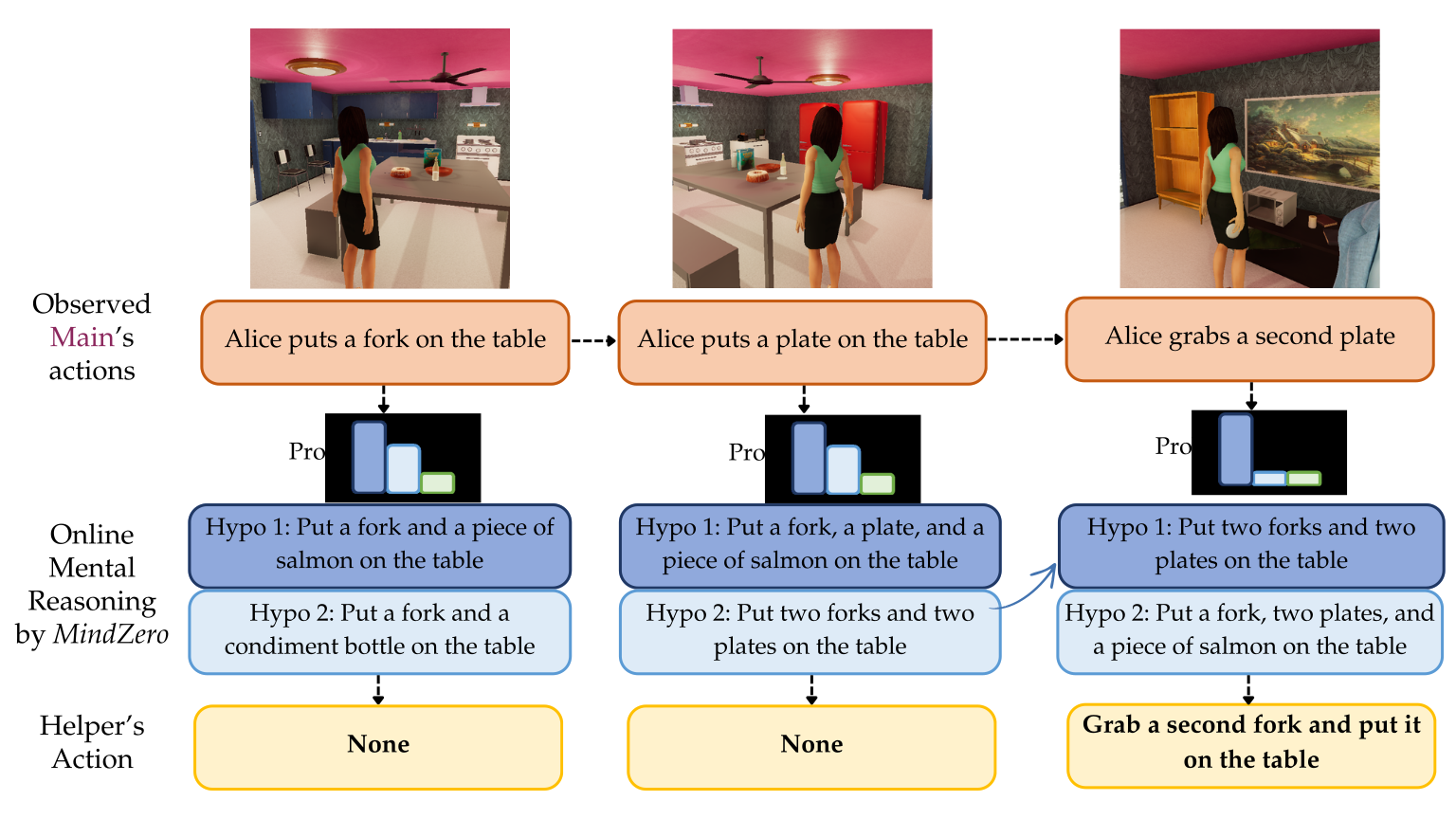
Effective real-world assistance requires AI agents with robust Theory of Mind (ToM): inferring human mental states from their behavior. Despite recent advances, several key challenges remain, including (1) online inference with robust uncertainty updates over multiple hypotheses; (2) efficient reasoning suitable for real-time assistance; and (3) the lack of ground-truth mental state annotations in real-world domains. We address these challenges by introducing MindZero, a self-supervised reinforcement learning framework that trains multimodal large language models (MLLMs) for efficient and robust online mental reasoning. During training, the model is rewarded for generating mental state hypotheses that maximize the likelihood of observed actions estimated by a planner, similar to model-based ToM reasoning. This method thus eliminates the need for explicit mental state annotations. After training, MindZero internalizes model-based reasoning into fast single-pass inference. We evaluate MindZero against baselines across challenging mental reasoning and AI assistance tasks in gridworld and household domains. We found that LLMs alone are insufficient; model-based methods improve accuracy but are slow, costly, and limited by backbone MLLM capacity. In contrast, MindZero enhances MLLMs' intrinsic ToM ability and significantly outperforms model-based methods in both accuracy and efficiency, showing that mental reasoning can be effectively learned as a self-supervised skill.

TL;DR: MindZero is a self-supervised reinforcement learning framework that trains multimodal language models to perform efficient online Theory-of-Mind reasoning with zero mental-state annotations.

ProToM: Promoting Prosocial Behaviour via Theory of Mind-Informed Feedback
Matteo Bortoletto, Yichao Zhou, Lance Ying, Tianmin Shu, Andreas Bulling
ACL Findings, 2026
[Abs]   [PDF]   [arXiv]   [Code]   [Website]
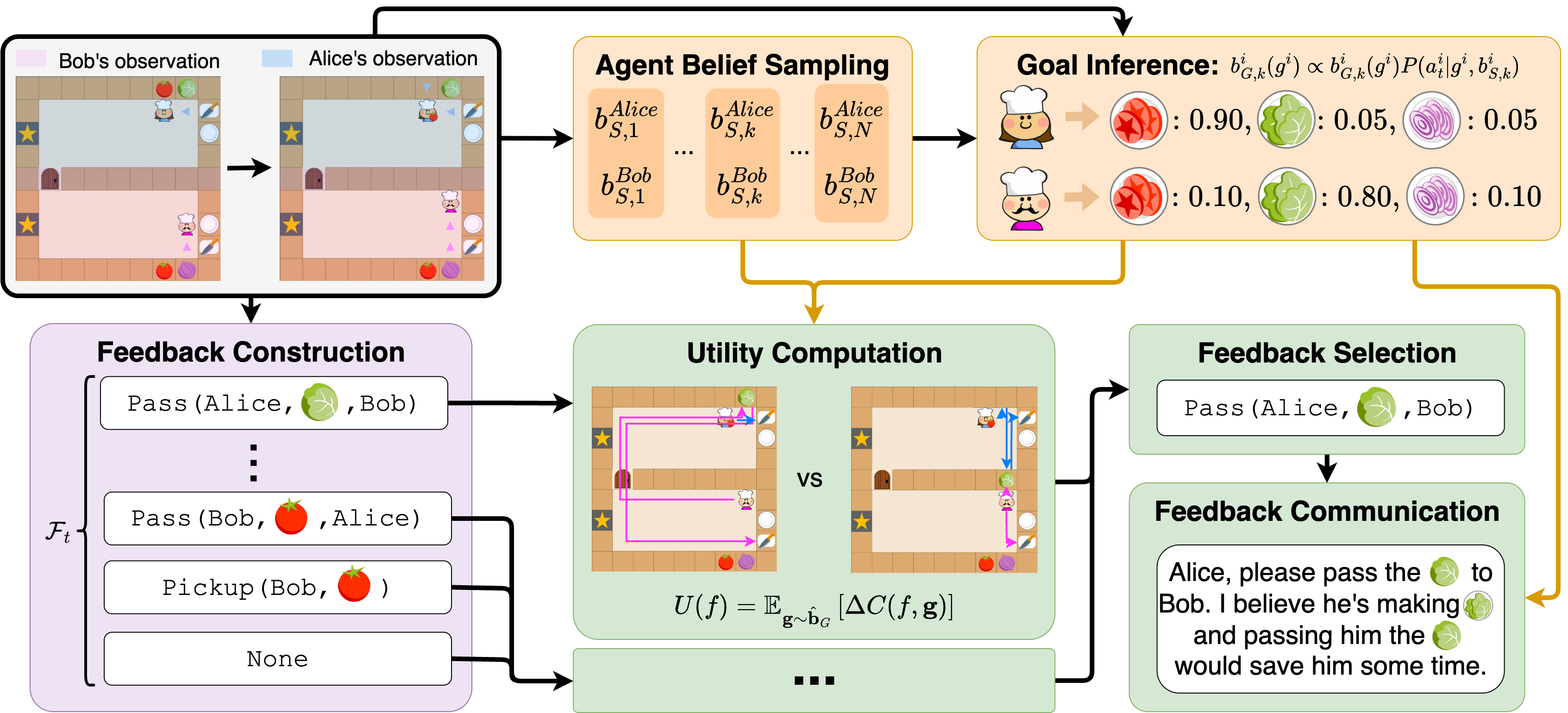
While humans are inherently social creatures, the challenge of identifying when and how to assist and collaborate with others - particularly when pursuing independent goals - can hinder cooperation. To address this challenge, we aim to develop an AI system that provides useful feedback to promote prosocial behaviour - actions that benefit others, even when not directly aligned with one's own goals. We introduce ProToM, a Theory of Mind-informed facilitator that promotes prosocial actions in multi-agent systems by providing targeted, context-sensitive feedback to individual agents. ProToM first infers agents' goals using Bayesian inverse planning, then selects feedback to communicate by maximising expected utility, conditioned on the inferred goal distribution. We evaluate our approach against baselines in two multi-agent environments: Doors, Keys, and Gems, as well as Overcooked. Our results suggest that state-of-the-art large language and reasoning models fall short of communicating feedback that is both contextually grounded and well-timed - leading to higher communication overhead and lower success rates. In contrast, ProToM provides targeted and helpful feedback, achieving a higher success rate, shorter task completion times, and is consistently preferred by human users.

TL;DR: To encourage prosocial interactions among human agents pursuing independent goals, we developed ProToM, a facilitator that promotes prosocial actions by communicating targeted, context-sensitive feedback to individual agents.

Teaching

I love teaching. I've served as a Teaching Assistant for three semesters for School of EECS, Peking University. Beyond grading and exam design, I lead weekly 2-hour recitation sessions, where I facilitate students' understanding of key concepts and complex algorithms. Guiding them to solve problems has been one of the happiest moments of my undergraduate life.

Introduction to Computation
Computer and Python programming foundation course for cross-departmental freshmen.
Fall 2023, Fall 2025
Instructor: Mr. Wei Guo

Slides and other course materials
Algorithm Design and Analysis
Core algorithm course for sophomores majoring in computer science and artificial intelligence.
Spring 2024
Instructor: Prof. Xiaolin Wang

Slides and other course materials
Experience
Harvard University, Cambridge, MA, USA
Starting Aug 2026

Incoming Master's Student
Master of Science in Data Science (MSDS)
Social Cognitive AI (SCAI) Lab, Johns Hopkins University, Baltimore, MD, USA
Jul 2024 - Jan 2026

Research Intern
Advisor: Prof. Tianmin Shu
Cognitive Reasoning (CoRe) Lab, Peking University, Beijing, China
May 2023 - Present

Student Researcher
Advisor: Prof. Yixin Zhu
Peking University, Beijing, China
Sep 2021 - Jul 2026

Undergraduate Student
PKU Zhi Class (Honors Program in AI)
Friends

I'm fortunate to have met some great people and shared many wonderful moments with them (in alphabetical order):

Matteo Bortoletto   Zhengtao Han   Zimo He   Guangyuan Jiang   Hongjie Li   Mao-Jan Lin   Yuxi Ma   Yongqian Peng   Shuwen Qiu   Jeff Wang   Yifei Wang   Yifan Yin   Saiyao Zhang   Zhining Zhang   Yan Zhong  


Last updated: Jun. 2026
Template from Jon Barron
Thanks Hongjie Li for sharing the template and some materials.